
A sauce bottle leaving the line with the brand sitting two millimetres off-centre. A carton that needs a second pass because the barcode will not scan. Two people still peeling and placing labels at the end of the shift while the filler sits idle. If any of that is happening on your floor, the labelling station is already costing more than the label stock.
Most New Zealand plants do not start the day looking for labelling machines. They start looking for a way to stop reprints, crooked application and the extra labour that creeps in once order volumes rise. The right machine is the one that matches the pack shape, the label position and the speed of the rest of the line. The wrong one is usually a generic unit bought on price, then left fighting bottles that will not stand, labels that wrinkle, or a conveyor that the head cannot keep up with.
This guide walks through how industrial labelling machines actually differ, which style suits which pack, and what to have ready before you ask Minipack Quickshrink for a recommendation.
Why labelling problems show up as production problems
A label looks like a finishing step. On a busy line it is often the thing holding everything else up.
Hand application is fine when a few dozen units leave the bench each hour. Once the filler, capper or carton sealer starts to outrun the people with the label rolls, packs queue up. Staff get pulled off packing or picking. Accuracy slips as the shift wears on. Retailers reject cartons with unreadable barcodes. Export customers send photos of wrinkled wrap-around labels. None of that appears on a purchase order as “labelling”, but that is where it starts.
There is also a consistency problem that labour cannot solve for long. Two operators will not place a front and back label in the same spot all day. A servo-driven head on a stainless frame will, provided the product is presented the same way each time. That is the real reason plants move to product labelling machinery: not because labels are fashionable, but because the rest of the line cannot afford a messy last step.
What labelling machines actually do on a packing line
At the simplest level, a labeller takes a label off a roll and places it on a moving or presented pack. The useful differences sit in how the product is held, where the label lands, and whether a person still has to present each item.
Minipack Quickshrink supplies a range of labelling machines covering semi-automatic bench work through to in-line heads that sit over an existing conveyor. Across the automatic models, the common building blocks are a stainless steel 304 frame, a PLC with a touch screen, and a servo-driven labelling head. Several of the bottle machines hold labelling accuracy to a ±1 mm tolerance and use a bottle separating wheel so packs do not crash into each other as they enter the head.
Those details matter more than the photo on the product page. A wrap-around unit is built around a press belt and a separating wheel. A top labeller on a movable stand is built around matching conveyor speed. A twin-side machine adds a sponge press so front and back labels sit flat. Buy the wrong family and you can own a perfectly good head that still cannot handle the bottle in your hand.
Match the machine to the pack, not the brochure
Start with the pack in your hand, not with a model name.
Round bottles and wrap-around labels
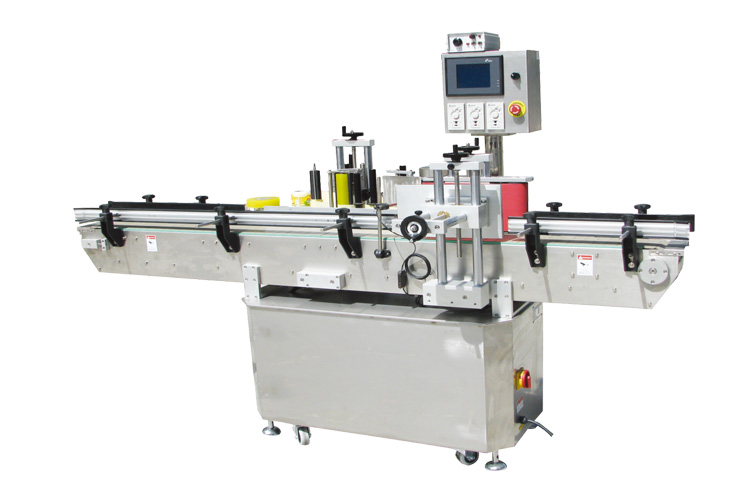
Round bottles and jars usually need a partial or full wrap. The Minipack Wrap Around Labeller is built for that job. It applies partial or fully wrap-around labels on round bottles and containers. The labelling head is servo driven, and labelling speed is automatically synchronised with the conveyor and the top press belt. A bottle separating wheel keeps a gap between packs so the next bottle does not shove the last one out of register.
That combination is what keeps a wrap-around label from spiralling up the bottle. If the press belt and the conveyor are not talking to the same speed signal, the label walks. If bottles enter nose to tail, the second pack knocks the first while the label is still being laid down. Those are mechanical problems, not operator problems.
Flat, oval and twin-side packs
Many household and food packs are flat or oval and need a front and a back label in one pass. The Minipack Twin Side Labeller is designed for twin-side labelling on flat or oval containers, and for positioned twin-side labelling on round bottles. A push-and-press sponge attachment is used so the label sits smooth, without wrinkles or bubbles. It also carries a positioning wrap station for partial wrap-around work on round containers.
Where the pack is round or square and the label is a front-and-back partial wrap, the Twin Side Labeller with Wrap Station is the closer match. Same stainless construction and ±1 mm tolerance, with a wrap station dedicated to that partial wrap on round containers.
If your range includes both oval detergent bottles and round sauce bottles, say so early. One head family can cover more than one shape, but only if the station and the guides are specified for the mix. A machine bought solely around the current hero SKU often becomes a changeover headache six months later.
Top, bottom and side labels on moving product
Not every label sits on the wall of a bottle. Cartons, clamshells, trays and flow-wrapped packs often take a label on the top face, the base, or one side as they travel.
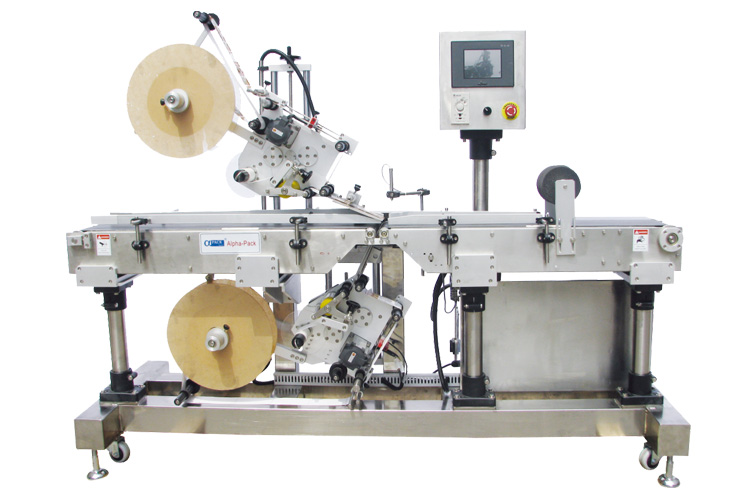
The Minipack Top Flat Labelling Machine is built for top labelling on flat products. The head sits on a movable stand so it can be shifted to the position the line actually needs. It is intended for labelling product as it moves on a conveyor. Speed can be matched either by fitting a speed-detect encoder on the customer’s conveyor, or by entering a fixed speed value on the touch screen when the conveyor runs at a constant rate.
The On Line Top Labeller with Stand follows the same idea: stainless frame, servo head, movable stand, and the same encoder or touch-screen speed options. The Side Labelling Machine with Stand uses that same movable-stand approach for a side face rather than the top.
When a pack needs a label on the top and the base in one pass, the Top and Bottom Labeller uses two heads. Labelling speed is automatically synchronised with conveyor speed. That is the machine to look at for flat products that carry a brand mark on top and a barcode or batch mark underneath.
These stand-mounted heads are often the practical answer when the packing line already exists. You are not ripping out a conveyor. You are adding a labelling station that can be lined up with the product path you already have.
Unstable packs that will not stand
Ampoules, vials, crayons, tubes, lip balm pots and small batteries will not sit still on a standard bottle conveyor. A vertical wrap-around machine will spend the shift knocking them over. The Horizontal Wrap Around Labeller is designed for non-standing round bottles and containers that are not vertically stable, including round-bottom or top-heavy packs in those categories.
If the product rolls, tips, or has no flat base, treat that as a selection criterion, not an afterthought. It is one of the more common reasons a “standard” labeller fails on a cosmetics or healthcare line.
Semi-automatic versus automatic labelling machines
Automation is not a single step.
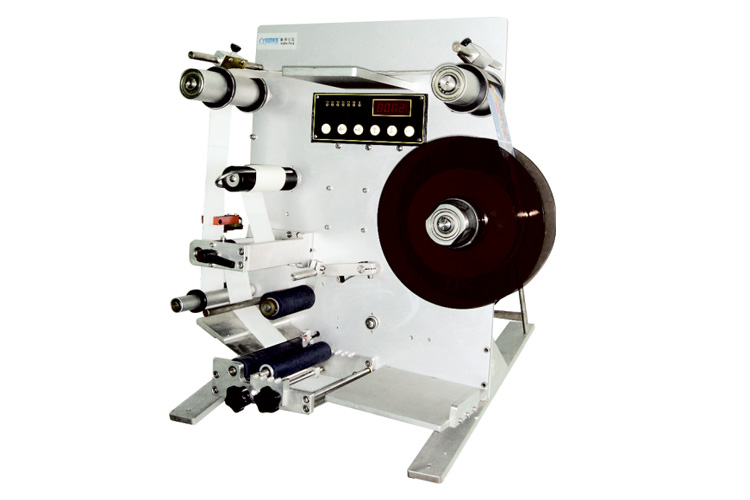
The Minipack Semi-Automatic Labelling Machine is described as an economical, easy solution that is almost suitable for all applications. It uses an aluminium construction, is built for high labelling accuracy, and can be supplied as a custom-made machine. Operation is straightforward, which is why it suits short runs, mixed SKUs, or a plant that is not yet ready to dedicate a conveyor lane to labelling.
A semi-automatic unit still needs a person to present the pack. What it removes is the variation that comes from peeling labels by hand. For a small beverage producer, a contract packer with frequent changeovers, or a warehouse applying compliance labels to mixed cartons, that is often enough.
Automatic labelling machines take over presentation as well. Bottles are separated, driven past the head, pressed, and released. Output is then limited by conveyor speed, pack stability and how quickly the line upstream can feed the station. That is the point where labelling stops being a bench task and becomes part of the packaging system.
There is no magic daily count that applies to every plant. A simpler test works better. If labelling regularly holds up filling, capping or despatch, or if two people are permanently assigned to a job one station could do, the semi-automatic bench is already undersized.
Buying considerations that change the quotation
Two plants can ask for “a labeller” and need completely different machines. The quotation only becomes useful once these points are on the table.
Product mix and changeovers
List the packs, not just the busiest one. Note diameter or width, height, material (glass, PET, HDPE, carton board, film), and whether the surface is wet, dusty or freshly filled. Record label size, whether it is paper or film, and whether you need a full wrap, a front and a back, a top face, or a base barcode.
Changeover time is a commercial issue. A line that runs one bottle all week can live with more setup. A co-packer swapping SKUs twice a day needs clear recipes on the touch screen and guides that operators can reset without a fitter on speed dial.
Conveyor speed and line layout
Stand-mounted top and side heads are designed to work with product already moving. If the conveyor speed varies, an encoder is the cleaner option. If it is a fixed-speed belt, entering the value on the touch screen is usually enough. Either way, the labeller has to see the same speed as the belt. Guessing that later is how labels start to skew after lunch when someone turns the conveyor up.
Floor space, infeed height and the gap between the filler and the case packer all matter. So does whether packs arrive standing, lying down, or in random orientation. Minipack Quickshrink also supplies conveyors, which is relevant when the current belt cannot present product square to the head. A labeller cannot fix a twisted infeed.
Accuracy, construction and the working environment
Several of the automatic bottle machines are specified at ±1 mm. That figure is only useful if the pack is guided. A wet glass bottle with condensation, or a soft pouch that flexes, will not hold that tolerance unless the presentation is right.
Stainless steel 304 is the standard construction on the automatic range, which suits food and wash-down areas better than a painted mild-steel frame. The semi-automatic unit is aluminium. Neither claim should be stretched into a hygiene certification that is not on the product page. If the room is hosed down every night, say so. If it is a dry warehouse, that changes the conversation.
Support after the machine is installed
A labelling head is a wear item in slow motion. Rollers glaze, sensors drift, and label-web paths pick up adhesive. Minipack Quickshrink installs its machines in New Zealand, offers contracts for routine and unscheduled maintenance, carries out repairs at the Auckland office, and provides technical support at the customer’s site. Authorised technicians are available for commissioning and for ongoing work. There is also a showroom in Auckland where machinery can be seen before a decision is locked in.
Local packaging machine servicing is not a luxury on a machine that sits in the middle of a filling line. When the head stops, the filler usually stops with it.
A practical picture from a growing food line
Take a North Island sauce maker that has outgrown the packing bench. Two staff still label 375 ml glass rounds by hand after the filler. Front labels wander. A few cases a week come back from a supermarket DC because the barcode sits over the glass seam. The same business has just won a house-brand contract for an oval plastic bottle that needs a front and a back label.
Buying a wrap-around machine alone would fix the glass round and leave the oval contract in the same mess. Buying a twin-side machine without talking through the glass bottle would do the reverse. The useful conversation is about both SKUs, the daily counts, whether the bottles leave the filler wet, and whether there is already a conveyor between the capper and the carton sealer.
A second picture: a contract packer applying top labels to cartons of supplements. The cartons already travel on a belt. A movable-stand top labeller, speed-matched to that belt, is a smaller intervention than a full bottle line. The mistake would be specifying a wrap-around bottle machine because that is what came up first in a search for labelling machines.
Neither example is a case study with invented savings. Both are the sort of mix Minipack Quickshrink sees when a New Zealand plant asks for help. The machine follows the pack, not the other way around.
Commercial takeaway: what to gather before you enquire
Before you request advice, put the following in one note. It will shorten the back-and-forth and stop the quotation drifting toward the wrong family of machine.
- Pack shapes and materials for every SKU that will use the station, not only the hero product
- Label type, size and position (wrap-around, front and back, top, base, side)
- Rough daily or hourly output, plus any peak that hits before a truck leaves
- How product is presented today: by hand, on a conveyor, standing or lying down
- Available floor length and the height of any existing belt
- Whether the area is washed down, and whether packs are wet or dusty at the labelling point
- Who will run changeovers, and how many times a day that happens
- Whether you expect new pack formats in the next year or two
With that list, the team can point you toward a semi-automatic bench machine, a wrap-around bottle labeller, a twin-side station, a top or side head on a stand, or a horizontal unit for packs that will not stand. The decision should rest on output, products, workflow and future growth, not on which photo looks busiest.
Conclusion
Labelling machines earn their place when they stop a packing line from waiting on a pair of hands. The choice is not “buy a labeller”. It is matching wrap-around, twin-side, top, bottom, side or horizontal application to the packs you actually run, then deciding whether a person still presents each item or the conveyor does.
Minipack Quickshrink has supplied New Zealand manufacturers since 1986, with nationwide sales support, site demonstrations and after-sales maintenance. The labelling range sits alongside the rest of the packaging machinery the team already supports, which matters when the labeller has to live next to a filler, a sealer or a case packer.
If the labelling station is the slowest, messiest or most labour-heavy step on the line, contact Minipack Quickshrink with the pack and output notes above. The team can help you select a suitable machine and talk through installation and servicing before anything is ordered.
Questions about labelling machines
How does a business know it has outgrown hand labelling? When labelling regularly holds up filling, capping or despatch, or when two people are permanently assigned to placing labels, the bench process is already undersized. Crooked barcodes, wrinkled wrap-arounds and rising reprint rates are the usual early signs. A semi-automatic machine is often the first step. A conveyor-fed automatic station is the next one if volume keeps climbing.
What is the difference between a wrap-around labeller and a twin-side labeller? A wrap-around labeller applies a partial or full wrap on round bottles and containers, using a press belt and a separating wheel to keep the label true. A twin-side labeller applies front and back labels on flat or oval packs, and can position twin-side labels on round bottles. Some twin-side models add a wrap station for partial wraps. The pack shape decides the family, not the other way around.
Do automatic labelling machines need their own conveyor? Not always. Several Minipack top and side heads sit on a movable stand and label product already moving on the customer’s conveyor. Speed is matched with an encoder or a fixed value on the touch screen. Dedicated bottle machines include their own infeed, press belt and separating wheel. The existing layout decides which approach is cleaner.
How accurate are industrial labelling machines? The automatic wrap-around, twin-side and top-and-bottom models in the Minipack range are specified at a ±1 mm labelling tolerance. That figure assumes the pack is guided and presented consistently. Soft pouches, wet glass and unstable tubes will not hold that tolerance unless the infeed and the machine family are chosen for those packs.
Is a semi-automatic labelling machine enough for a small food producer? Often, yes. The semi-automatic Minipack unit is built as a low-cost, easy-to-run option and can be supplied as a custom-made machine. It still needs an operator to present each pack, so it suits short runs and mixed SKUs. Once labelling becomes the reason the filler waits, it is time to look at an automatic station.
What information should be ready before requesting a labelling machine quote? Have pack drawings or samples, label size and position, hourly output, how product is presented today, conveyor height if one exists, and notes on wash-down or wet packs. Mention planned new SKUs. That list lets the supplier recommend a machine family instead of a generic unit that will not fit the line.
Why does local servicing matter on a labeller? A labelling head sits in the middle of the packing sequence. When it stops, filling and despatch usually stop with it. Minipack Quickshrink installs machines in New Zealand, offers routine and unscheduled maintenance contracts, repairs equipment in Auckland, and sends technicians to site. That support is part of the buying decision, not an extra to think about later.
Can one labeller handle both bottles and cartons? Sometimes a plant needs more than one station. A wrap-around or twin-side machine is built around bottles and similar containers. Cartons and flat packs usually need a top, bottom or side head. Forcing both jobs through one machine is a common way to end up with poor registration on both.